
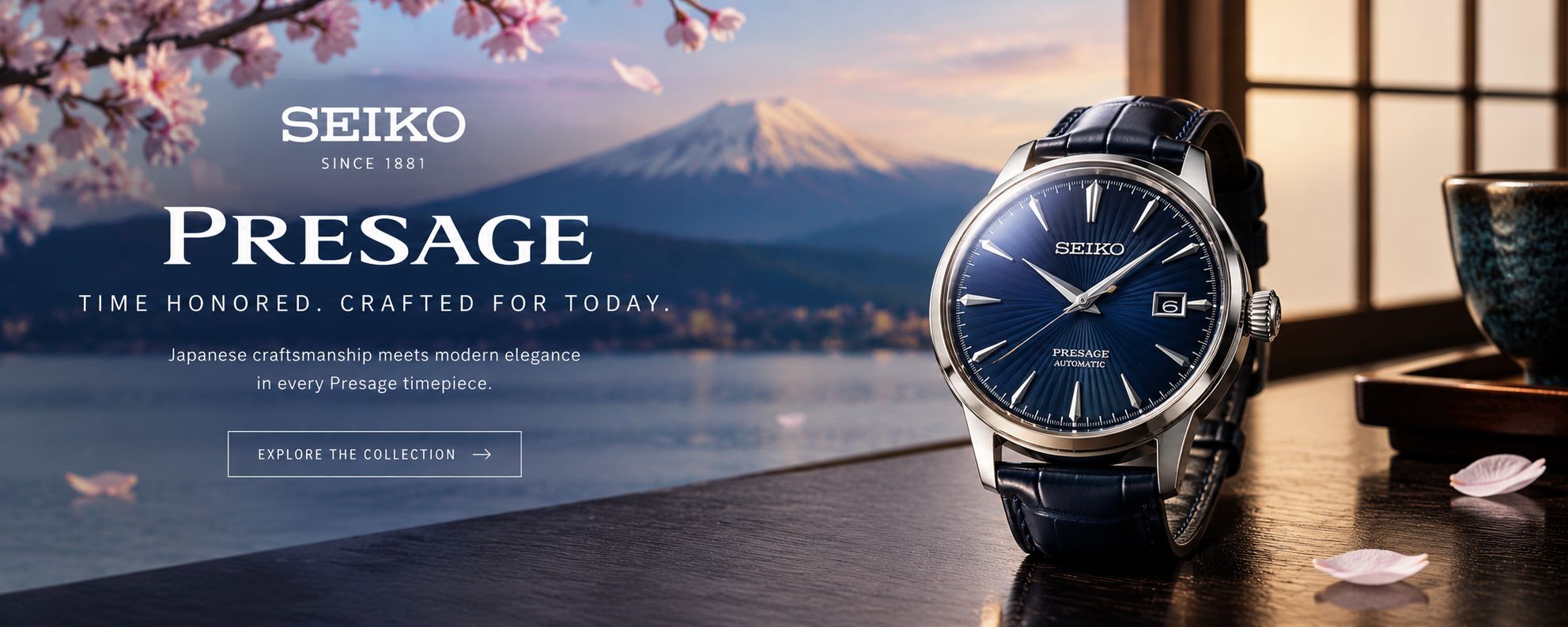
A watch dial is usually asked to do one thing: show the time. In Seiko’s Presage collection, it can also carry the quiet traces of a kiln, a lacquer workshop or a centuries-old porcelain tradition. That does not make every Presage a handmade objet d’art. Rather, the collection’s most distinctive models bring selected Japanese crafts into a thoroughly modern wristwatch—and let the materials speak for themselves.
Craft you notice in the light
Presage pairs mechanical watchmaking with a Japanese sense of proportion and finish. Its range is broad, but the Craftsmanship series makes that connection especially clear. Instead of relying only on printed patterns, certain models use enamel, Urushi lacquer, Shippo enamel or Arita porcelain. Each material has its own surface and its own way of catching the light.Enamel offers a soft, glass-like sheen and holds its colour beautifully. There is a particularly apt historical link here: enamel was used on the Laurel, Japan’s first wristwatch. Seiko Watch describes the work as exacting; its featured enamel craftsman, Mitsuru Yokosawa, can apply a coat as thin as 0.1 millimetre. That precision is not obvious as a specification on the wrist. It shows up as an even, smooth surface that looks simple because the difficult work has disappeared into the finish.Urushi takes a different route. Made from lacquer-tree sap, it is applied in layers and polished repeatedly. The result is not a flat, featureless black, but a deep gloss with a sense of depth. Some Presage dials go further, using techniques such as Byakudan-nuri and Maki-e to add subtle metallic colour and texture. Details like these reward a closer look without turning the dial into a crowded display.
Porcelain, brought down to watch scale
Arita porcelain has been made in Japan for more than 400 years. Translating it into a watch dial is a delicate proposition: porcelain is beautiful, but a wristwatch needs a material that can cope with everyday wear. Seiko says the dial material was developed to retain porcelain’s soft lustre while improving its strength. The finished surface has a gentle, almost milky glow, distinct from the sharper shine of enamel.Shippo enamel offers yet another character. Layers of glaze are applied and fired, then polished to reveal colour and depth. The process is painstaking, and the resulting dial can feel more painterly than metallic. These are not interchangeable decorations. Each technique changes the watch’s personality, even when the case and hands remain restrained.
Tradition without costume
The achievement of Seiko Presage is not simply that it borrows from traditional craft. It is that these materials still make sense as parts of a watch. They must work with the markers, hands and movement; they need to remain legible and wearable, not just impressive in a display case. Seiko’s mechanical watchmaking gives the collection its practical foundation, while the dial provides the individual note.That balance is worth keeping in mind when choosing a Presage. The collection includes different series and styles, and artisanal dials appear on particular models rather than every watch bearing the name. Check the exact reference for its movement, dimensions and dial material. Then consider what kind of surface you want to live with: enamel’s clean glow, Urushi’s dark depth, or porcelain’s softer sheen.Japanese artistry can sound like a grand promise. On a Presage dial, it is often quieter than that—a colour that shifts as the wrist turns, a polished surface that seems to hold light, or a tiny irregularity that reminds you a skilled person was involved. The time remains the point. The craft is what makes looking at it feel different.